As an Amazon Associate this site earns from qualifying purchases.
Specification comparison
| Product | Height | Width × Depth | Tiers | Stated weight limit | Price |
|---|---|---|---|---|---|
| VASAGLE CUSTOS Collection 6-Tier ULBC166T14 | 63.3" | 23.6" × 9.4" | 6 (4 adjustable, ±1.2", 3 positions) | 22 lb per tier | Check price on Amazon |
| Shintenchi 6-Tier Bookshelf, Modern Open Bookcase (Black) | 71" | Not stated | 6 | 396 lb maximum bearing capacity | Check price on Amazon |
| IRONCK Bookshelves and Bookcases Floor Standing 6 Tiers | 70.87" | 23.82" × 9.25" | 6 | 22 lb per shelf | Check price on Amazon |
| Sweetcrispy 5 Shelf Bookcase | 53" | 23.8" × 9.2" | 5 (10.5" per layer) | Not stated | Check price on Amazon |
| SUNMORY 6 Tier Tree Bookshelf | 47.4" | 14.6" × 7.9" | 6 tiers + 2 storage cabinets | Not stated | Check price on Amazon |
| Shintenchi Bookshelf with Doors (Black) | 70.9" | Not stated | 4 open shelves + 2 door levels | Not stated | Check price on Amazon |
Quick answer: Pick your bookshelf by measuring three things first — the wall width you can give up, the depth your floor can spare, and the height that clears your ceiling, vents and outlets — then match those numbers to a shelf with a stated per-tier weight limit and an anti-tip kit. For most rooms, a 23–24" wide, 9–10" deep, 53–71" tall unit is the sweet spot, which is exactly where the VASAGLE CUSTOS Collection - Bookshelf, 6-Tier Bookcase, Book Shelf, Open Storage Shelf, 9.4 x 23.6 x 63.3 Inches, for Living Room, Home Office, Dinning Room, Cloud White ULBC166T14 lands, with the added benefit that four of its six tiers adjust.
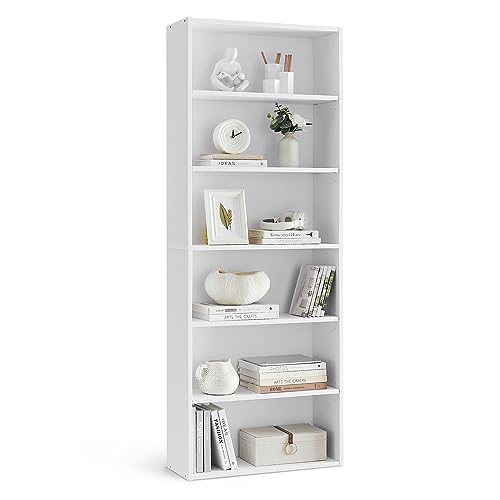
- 【COMPARTMENT DESIGN MEETS OPEN STORAGE】This bookshelf comes from VASAGLE CUSTOS Collection, characterized by the open compartment design that embodies easy-to-blend-in minimalism
- 【SPACE-SAVING & ADJUSTABLE】This 6-tier bookcase, measuring 9.4"D x 23.6"W x 63.3"H, optimizes vertical space. The 2nd, 3rd, 5th and 6th tiers are adjustable to 3 heights (up or
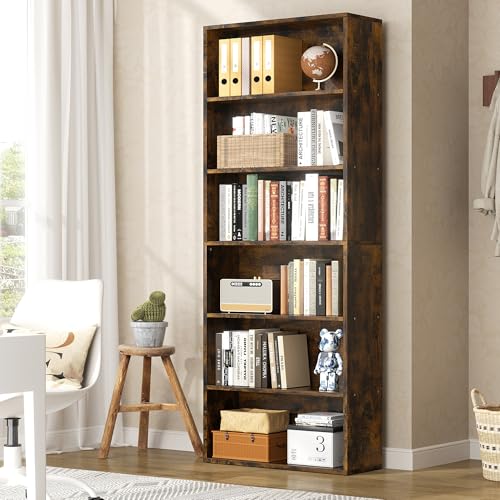
- Modern Industrial Style Display Storage Shelves:This home bookshelf with hard durable P2 grade MDF board, simple, sturdy, and functional. You can put it in your living room, study
- 6 Shelves Capacity: 6-tier open bookshelf can meet your storage needs, you can put your books, photos, collectibles and souvenirs on the industrial shelves, the maximum bearing
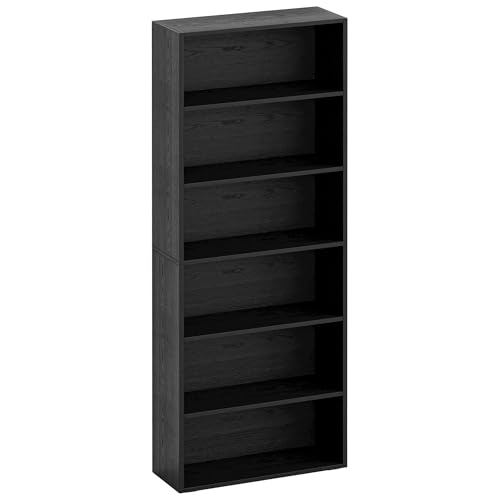
- Sturdy Material: Built with durable MDF particleboard, each shelf can hold 22 lb to keep your books in safe hands
- Stable Construction: With strengthen screws and the tipover resistance device, the bookcase is more stable
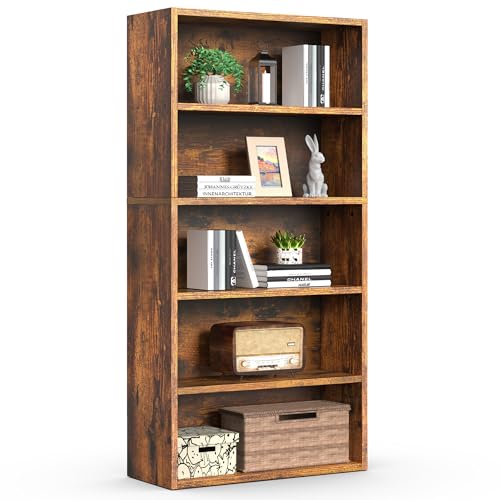
- Warm Tips: Be sure to tighten the screws to avoid wobbly bookcases, important reminder. And this bookcase comes with multiple parts so your patience is appreciated. Upon receipt
- A Solution for Storage: No more worries about storage space with our 5 tier bookcase that measures 9.2"D x 23.8"W x 53"H. Each layer, 10.5" high, is well-equipped to house your
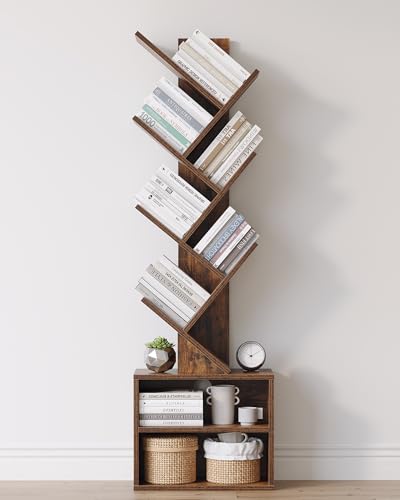
- Small Bookshelf for Small Spaces: Featuring a compact design, the floor standing tree bookshelf optimizes floor space, making it an excellent choice for bedrooms, home offices
- High-Capacity Tall Bookcase: This Wood Bookshelf offers 6 tier shelves and 2 open storage cabinets, providing ample space for storing 5-10 books on each shelf. Additionally, the 2
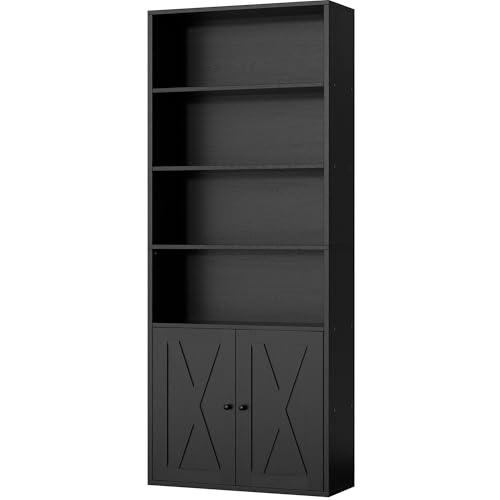
- Farmhouse Design Style: This modern farmhouse bookcase is the perfect combination of shelf and cabinet, special color collocation, has a beautiful appearance, is a perfect
- Modern Industrial Style Display Storage Shelves:This home bookshelf with hard durable P2 grade MDF board, simple, sturdy, and functional. You can put it in your living room, study
Start with three measurements, not with the product page
Depth. Standard hardcovers run about 6–9" deep; oversized art books and binders need more. A 9–10" deep shelf holds ordinary books fine and steals very little floor. Anything under 8" deep is a display shelf that happens to hold paperbacks.
Width. Measure the wall gap, then subtract 2–3" so the unit doesn't look wedged in. Most standing bookcases cluster around 23–24" wide; narrow corner and hallway units drop to roughly 8–15".
The best bookshelf buying guide for your situation depends on how you plan to use it and where.
Height. Tall units use vertical space you're already paying rent on, but check for a ceiling slope, a wall vent, a light switch, and — critically — where the wall studs are, because every unit here expects to be anchored. Also check the top shelf is reachable without a stool if you actually want to use it.
Then check the per-shelf weight limit, not the total. Books are heavy — a packed 24" shelf of hardcovers can push past 30 lb. Several of these list 22 lb per tier, which is fine for mixed decor, plants, boxes and paperbacks, and tight for a dense hardcover run.
Prices are what the data showed and move constantly — confirm on the listing.
Who the VASAGLE CUSTOS is for
If you don't yet know what's going on the shelf, adjustability is the feature that saves you. The 2nd, 3rd, 5th and 6th tiers move up or down 1.2" across three positions, which is the difference between a shelf that fits your tall art books and one where they lie on their sides forever. At 63.3" it's tall enough to be a real bookcase but short enough that most adults can reach the top tier, and 9.4" of depth is genuine book depth rather than decor depth. The H-shaped structure and slot-in back panel are there for rigidity, and an anti-tip kit is included.
It's a good fit for a home office wall, a living-room alcove, or a first apartment where the shelf may get repurposed twice before it retires.
Who should skip it
Skip it if you need serious load capacity: 22 lb per tier is the stated ceiling, and a dedicated hardcover or textbook library will exceed that. Skip it if Cloud White is wrong for your room — a light finish shows scuffs at ankle height in a hallway. Skip it if you want anything hidden; every tier is open, so whatever you put there is on display permanently. And skip it if your ceiling or wall run demands something over 63.3" tall or wider than 23.6".
The honest trade-offs
Everything in this price band is MDF or particleboard, not solid wood. That means it's light, affordable, and dimensionally predictable — and also that it will sag under sustained overload, dislikes damp basements, and does not survive being disassembled and rebuilt many times. Screws must be fully tightened or the frame racks and wobbles; the Sweetcrispy listing says this outright, and it's true of every unit here.
Assembly is genuinely a chore on tall multi-tier units regardless of how cheerful the listing sounds — budget an hour and a second pair of hands for the back panel.
And treat the anti-tip hardware as mandatory, not optional. Every product here ships some form of tipover device or bracket. A tall, narrow, top-heavy shelf in a home with kids or pets is a hazard until it's screwed to a stud.
What to check on the listing before you buy
- Current price and variant. Colour and size variants often sit on the same listing at different prices; the number you see may belong to a variant you didn't select.
- The exact dimensions of your chosen variant. Where width and depth aren't stated in the bullets, look for the manufacturer's dimension image or the product details table before ordering.
- Per-shelf vs. total weight capacity. These are very different claims. "396 pounds maximum bearing capacity" is not the same promise as "22 lb per tier."
- What's in the box. Confirm the anti-tip kit and tools are included for your variant.
- Warranty and return window, plus the seller's replacement-parts process — damaged panels in flat-pack furniture are common enough that this matters.
- Read recent reviews yourself, filtered to the newest ones and to your colour variant. Manufacturing changes; older reviews may describe a different product.
Alternatives worth a look
6-Tier Bookshelf, Modern Open Bookcase,6 Shelf Display Storage Shelves Floor Standing, 71 inches Tall Shelves for Home Office, Black — consider instead if…
…you want maximum height and the highest stated load figure here. The 6-Tier Bookshelf, Modern Open Bookcase,6 Shelf Display Storage Shelves Floor Standing, 71 inches Tall Shelves for Home Office, Brown stands 71" tall, uses P2-grade MDF, lists a 396 lb maximum bearing capacity and includes a rear stability device. Width and depth aren't stated in the bullets, so confirm those on the listing before you commit wall space.
IRONCK Bookshelves and Bookcases Floor Standing 6 Tiers Display Storage Shelves 70 in Tall Bookcase Home Decor Furniture for Home Office, Living Room, Bed Room — consider instead if…
…you want the tall-and-slim footprint with published numbers for all three dimensions. The IRONCK Bookshelves and Bookcases Floor Standing 6 Tiers Display Storage Shelves 70 in Tall Bookcase Home Decor Furniture for Home Office, Living Room, Bed Room measures 23.82" W × 9.25" D × 70.87" H, is built from MDF particleboard, holds 22 lb per shelf and includes a tipover resistance device. Essentially the VASAGLE footprint stretched about 7.5" taller, with fixed shelves.
Sweetcrispy 5 Shelf Bookcase Open Display Bookshelf Storage Organizer — consider instead if…
…you have a low ceiling, a window sill, or you want something that doesn't dominate the wall. The Sweetcrispy 5 Shelf Bookcase Open Display Bookshelf Storage Organizer is 53" tall at 23.8" W × 9.2" D, with 10.5" of clearance per layer, triangular corner reinforcements and mortise-and-tenon H-shape panel joins, plus a top iron anti-tip bracket. No per-shelf weight rating is stated, so treat heavy hardcover runs cautiously.
SUNMORY 6 Tier Tree Bookshelf, Tall Small Bookcase with Storage Cabinet — consider instead if…
…your "space" is a corner, a hallway, or the 15" gap beside a desk. At 47.4"H × 14.6"L × 7.9"W, the SUNMORY 6 Tier Tree Bookshelf, Tall Small Bookcase with Storage Cabinet is the narrow, low option here, with a branch-style tiered layout, two storage cabinets that can be merged for larger items, thickened MDF, a rustic brown faux-wood finish and included anti-tip accessories. The listing suggests 5–10 books per shelf — it's a supplement to a main bookcase, not a replacement.
Shintenchi Bookshelf, Industrial Bookshelves and Bookcases with Doors Floor Standing 6 Shelf Display Storage Shelves 70.9 inches Tall Bookcase for Home Office, Living Room (Black) — consider instead if…
…you need to hide some of what you're storing. The Shintenchi Bookshelf, Industrial Bookshelves and Bookcases with Doors Floor Standing 6 Shelf Display Storage Shelves 70.9 inches Tall Bookcase for Home Office, Living Room (Black) is 70.9" tall with 4 open shelves above and 2 levels of closed cabinet below for paperwork and dust-sensitive items, in P2-grade MDF with a rear stability device. It's the priciest here at $72.99, and width and depth aren't stated — check them on the listing.
FAQ
How do I choose the right size bookshelf for my space? Measure the wall width and subtract 2–3" for breathing room; choose 9–10" depth for real books; and pick a height that clears vents, switches and any ceiling slope while staying within your comfortable reach. Then confirm your intended contents fit the stated per-shelf weight limit.
Is a 6-tier shelf better than a 5-tier one? Not automatically. More tiers in the same height means shorter clearance per shelf, which is a problem for tall books. The Sweetcrispy 5 Shelf Bookcase states 10.5" per layer; on a 6-tier unit, check whether tiers adjust — the VASAGLE CUSTOS moves four of its six.
Do I really have to anchor it to the wall? Yes. Every unit listed here ships an anti-tip bracket, device or kit. Tall, shallow, book-loaded furniture tips forward easily, and anchoring takes ten minutes.
Will MDF hold up long term? For normal book and decor loads, yes — as long as you respect the stated limit, keep it dry, and tighten every fastener during assembly. Overloading a shelf beyond spec is what produces the sagging middle shelf people complain about.
Related guides
- Step-by-Step Best storage and organization furniture - bookshelves, storage cabinets, closet organizers, shoe racks, storage benches, pantry cabinets, cube storage, ladder shelves, coat racks, over the toilet storage Process
- How to Choose a Storage Cabinet That Actually Fits
- FAQ: Best storage and organization furniture - bookshelves, storage cabinets, closet organizers, shoe racks, storage benches, pantry cabinets, cube storage, ladder shelves, coat racks, over the toilet storage
Key Takeaways
- Choosing the right bookshelf buying guide means matching the key features to your specific needs and budget
- Read real customer reviews and check the return policy before you commit
- Compare value across models — the priciest option is not always the best fit