As an Amazon Associate this site earns from qualifying purchases.
Specifications at a glance
| Product | Tiers | Dimensions | Material | Stated capacity | Price |
|---|---|---|---|---|---|
| SONGMICS Shoe Rack, 3-Tier | 3 | 11.8"D x 36.2"W x 21.7"H | Metal tubes, plastic connectors | 16 pairs men's / 20 pairs women's; 22 lb per tier | Check price on Amazon |
| Kitsure Shoe Rack, 3 Tier | 3 | 27.5" wide (depth/height not stated) | Metal tubes, plastic frames, non-woven fabric shelves | Not stated | Check price on Amazon |
| VTRIN 10 Tier Shoe Rack | 10 | 34"L x 10"W x 68"H | Iron pipes, plastic connectors, non-woven fabric | Up to 4 pairs per layer | Check price on Amazon |
| ROMGUAR CRAFT 3 Tier Bamboo | 3 | 27" x 11" x 20" | Carbonized bamboo | Not stated | Check price on Amazon |
| SNTD Expandable Metal Shoe Rack | 2 | Expands 18.6" to 30.5" wide | Coated heavy-duty metal, mesh wire shelves | Up to 8 pairs | Check price on Amazon |
| KEETDY 3-Tier Long Shoe Rack | 3 | 43"W x 11.4"D x 24.4"H | Metal wire grid | 24 pairs; 8" shelf spacing | Check price on Amazon |
Quick answer: For most entryways and closet floors, a stackable metal or bamboo rack in the 3-tier, 27–43 inch wide range covers a whole household's daily shoes for under $35. The two specs that actually decide whether you'll be happy are shelf-to-shelf height (boots need roughly 8 inches or more) and total width, because a rack that's an inch too wide for your closet is a return, not a compromise.
Shoe racks are one of the few furniture categories where the cheap option is often genuinely fine. The failure modes are boring and predictable: it doesn't fit the space, boots won't stand up in it, or the fabric shelves sag under a pile of sneakers. Get those three right and the rest is preference.
SONGMICS Shoe Rack, 3-Tier — the reference point for this guide
The SONGMICS Shoe Rack, 3-Tier Shoe Organizer, Metal Storage Shelf, Upright or Upside Down, for 16-20 Pairs, Stackable, for Entryway, 11.8 x 36.2 x 21.7 Inches, Black ULSA303B02 is a useful yardstick because it publishes the numbers most listings hide: 22 lb per tier, 36.2 inches wide, 11.8 inches deep, and a rated 16 pairs of men's shoes or 20 women's. It assembles without tools, stacks with a second unit, and can be flipped upside down to open extra floor clearance underneath — a genuinely clever bit of flexibility for a rack in this price range.
The best shoe rack buying guide for your situation depends on how you plan to use it and where.
Measure your gap, compare it to 36.2 inches, and you'll know in ten seconds whether this shape works for you.
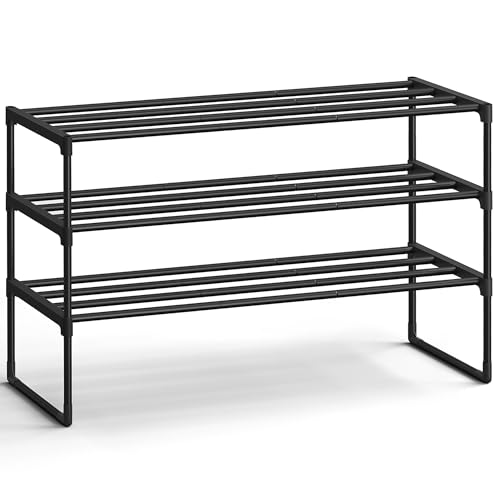
- 【FLEXIBLE & VERSATILE】The shelf can be used flexibly—stand it upright; flip it over to gain additional storage space under the shelf; stack 2 shelves on top of each other to make
- 【SPACIOUS】The shelf measures 11.8"D x 36.2"W x 21.7"H. When used upside down, it can accommodate up to 16 pairs of men's shoes or 20 pairs of women's shoes. With the optimal
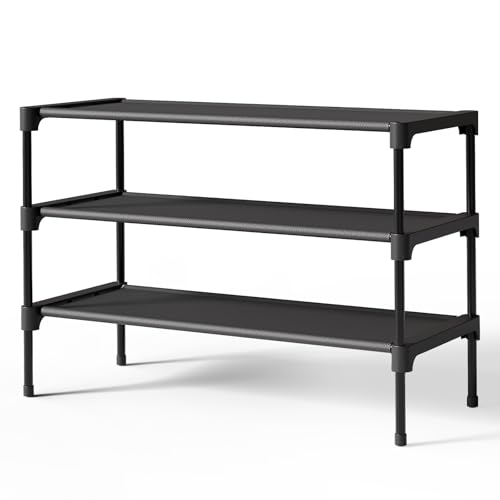
- SPACIOUS STORAGE: This shoe rack offers plenty of space to accommodate your everyday footwear, including sneakers, heels, and slippers. It's designed to meet all your storage
- MATERIAL: Made from metal tubes with plastic frames. The non-woven fabric shelves protect footwear from scuffs while preventing dust from falling through layers, keeping your
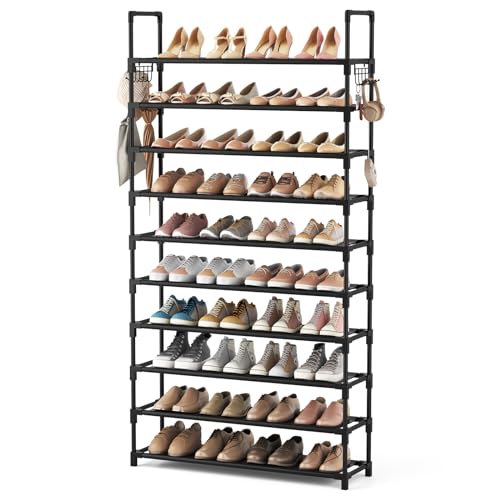
- 【Large Capacity 10 Tier Wide Shoe Rack】The 10 tier shoe organizer can store up to 4 pairs of adult shoes per layer, and you can remove one layer to fit long boots. This shoe
- 【Sturdy Material & Compact Structure】The shoe rack tall is made of durable waterproof non-woven fabric layers, reinforced plastic connectors and thickened iron pipes, good
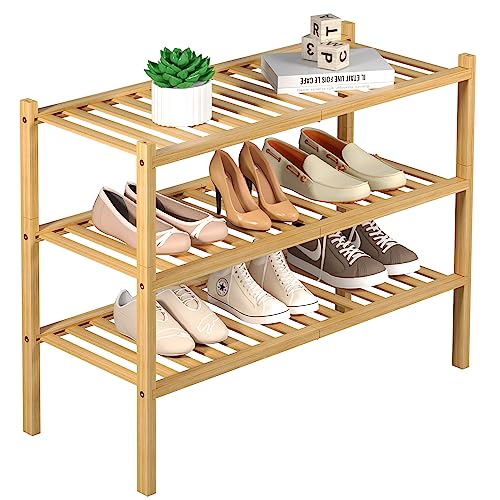
- 【Preferred high-quality bamboo】The entryway shoe rack is made of eco-friendly bamboo for an elegant look and very durable. After high temperature carbonization,not easy to crack
- 【Stackable Design 】Each type of outdoor shoe rack is stackable, and the combinations are constantly changing. Two 2-tier shoe rack units can be stacked into a 4-tier shoe rack
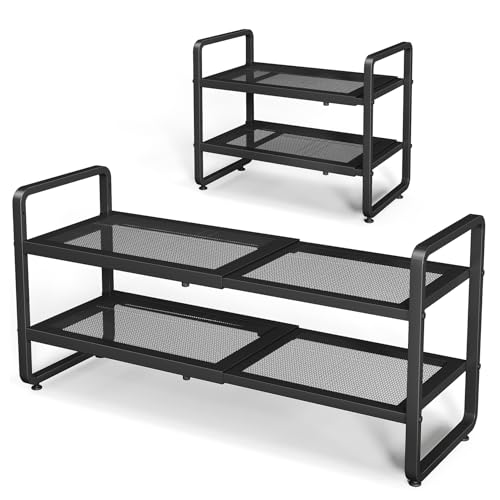
- Expandable Shoe Rack: This shoe rack can be extended from 18.6" to 30.5" and hold up to 8 pairs of shoes on the shelves, which is perfect space solution for shoes organization of
- Height Adjustable and Stackable: You can adjust the height of the shoe stand to fit taller boots as per your needs. Meanwhile, the shoe organzier can be purchased more to stacke
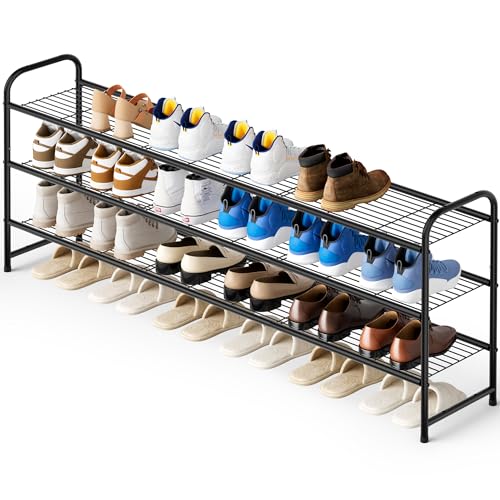
- 【Heavy Duty Metal Shelf】 This men shoe rack are very sturdy that does not rust or deform, sturdy enough to fill the entire black shoe rack with shoes. Load bearing capacity is
- 【Display Boots Easily】 Unlike other 3 tier shoe rack that can only store flat shoes, our wide shoe rack organizer fit boots well, the height of shelf distance is 8 inches, roomy
Who a rack like this is for
- Entryway pile-up households. If four people kick shoes off inside the door, you want horizontal capacity at floor level, not a tall tower.
- Renters. Tool-free assembly, no wall anchors, and it comes apart when you move.
- Closet floors. A 21.7-inch-tall rack slides under hanging clothes without fighting the rod.
- People who want it solved this week. Nothing here needs a drill, a stud finder, or a weekend.
Who should skip it
- Anyone storing mostly tall boots. A 3-tier rack at ~21 inches total height gives each shelf roughly seven inches of clearance. Riding boots and tall rain boots will not stand up. Look for racks that let you remove a shelf, or buy a 2-tier with adjustable height.
- Anyone who wants furniture, not a rack. These are open metal and fabric frames. If the shoes are visible from your living room and that bothers you, you want an enclosed shoe cabinet or a storage bench instead.
- Very heavy loads. A 22 lb per-tier rating is fine for sneakers and flats. It is not a place for tool bins or a stack of hardcovers.
- Awkward narrow nooks under 18 inches. Most fixed-width racks start around 27 inches. You need an expandable model or a tower.
The honest trade-offs
Fabric shelves vs. wire grids. Non-woven fabric, like the shelves on the Kitsure and VTRIN racks, is gentler on shoe finishes and stops dust from sifting onto the pair below. It also sags over time under heavy shoes and is harder to clean than metal you can wipe or rinse. Wire grids hold shape and support boots better, but thin heels can tip if the mesh is loose — which is why SNTD specifically calls out a taut mesh grip for heels.
Cheap vs. rigid. Under about $18, you're buying metal tubes pushed into plastic connectors. That construction is light, tool-free, and honestly adequate — but the joints are the weak point, and racks in this class flex if you lean on them. Above $25 you generally get welded or heavier-gauge metal that doesn't wobble.
Tall vs. wide. A 10-tier tower stores far more shoes per square foot of floor. It also becomes a tip hazard in a hallway with kids or pets, and the top two tiers are annoying to reach daily. Wide low racks are more usable; tall racks are more efficient.
Stacking is the real feature. Almost every rack here stacks. That means you can start with one, live with it for a month, and buy a second unit if you underestimated. It's a better strategy than guessing big on day one.
What to check on the listing before you buy
Listings change constantly, and the same ASIN often covers several sizes and finishes. Before checkout:
- Confirm the price today. Every price in this guide is a snapshot and these products move around.
- Check which variant is selected. Colour, tier count, and width are frequently separate options at different prices — the photo you clicked may not match the dropdown.
- Re-read the dimensions on the current listing and hold them against a tape measure in the actual spot. Note whether the number quoted is the assembled footprint or a single module.
- Look for the warranty or return terms. Several brands here mention after-sales support (VTRIN and ROMGUAR CRAFT both do), but the specific terms live on the listing, not in a guide.
- Go read the recent reviews yourself, filtered to the variant you're buying, and skim the customer photos — they show real-world sag and fit better than any spec sheet.
Consider instead if…
Kitsure Shoe Rack - Non-Woven Shoe Rack Shelf, 27.5" Wide - 3 Tier, Black — consider instead if…
…you want the lowest-risk experiment possible. At $9.99, the Kitsure Shoe Rack - Non-Woven Shoe Rack Shelf, 27.5" Wide - 3 Tier, Black is cheap enough to try in a dorm, garage, or walk-in closet without much thought. It's 27.5 inches wide, assembles in four steps with no screws or tools, stacks with additional units, and uses non-woven fabric shelves that keep dust and scuffs off the pairs below. The listing doesn't state a pair capacity or full dimensions, so measure with the width figure only.
VTRIN 10 Tier Shoe Rack Tall Large Capacity Wide Shoe Organizer with Two Hooks Sturdy Metal Shoe Shelf for Entryway, Closet, Bedroom — consider instead if…
…you have a shoe problem, not a shoe rack problem. The VTRIN 10 Tier Shoe Rack Tall Large Capacity Wide Shoe Organizer with Two Hooks Sturdy Metal Shoe Shelf for Entryway, Closet, Bedroom is 34" long x 10" deep x 68" tall and holds up to four adult pairs per layer across ten tiers. You can remove a layer for tall boots, split it into two 5-tier units, and hang keys, umbrellas, or bags from the hooks. It uses waterproof non-woven fabric shelves on thickened iron pipes, and assembly is done by tapping the joints with an included wooden hammer. At 68 inches tall in a narrow footprint, put it against a wall.
ROMGUAR CRAFT 3 Tier Bamboo Shoe Rack — consider instead if…
…the rack is going somewhere people can see it. The ROMGUAR CRAFT 3 Tier Bamboo Shoe Rack for Closet Free Standing Wood Shoe Shelf Storage Organizer for Entryway Small Space Stackable 27"x11"x20" (Natural) trades metal-and-plastic for carbonized bamboo, which the brand notes resists cracking and warping. At 27" x 11" x 20" it's the most compact footprint here, it stacks into 4- or 6-tier configurations, and assembly is quoted at about ten minutes. Bamboo also happily doubles as bathroom or living-room shelving if the shoe phase ends.
Expandable Metal Shoe Rack for Closet, Entryway & Garage, 2-Tier, Black — consider instead if…
…your space is an awkward width, or you own heels and boots. The Expandable Metal Shoe Rack for Closet, Entryway & Garage, 2-Tier, Black from SNTD extends from 18.6 to 30.5 inches and holds up to eight pairs, with adjustable height so taller boots actually fit and adjustable feet for uneven garage floors. The mesh wire shelves are built taut specifically so thin heels don't teeter. It's the priciest option here at $35.99 and only two tiers, but it's heavy-duty coated metal and stacks up to 10 tiers if you buy more.
KEETDY 3-Tier Long Shoe Rack for Closet — consider instead if…
…you need maximum capacity along a wall. The KEETDY 3-Tier Long Shoe Rack for Closet Metal Shoe Organizer for Entryway, Wide Stackable Shoe Storage Shelf with Sturdy Wire Grid for Closet Floor, Bedroom, Black is 43" wide x 11.4" deep x 24.4" tall and rated for 24 pairs, with roughly 8 inches between shelves — enough that snow and rain boots keep their shape rather than folding over. Two sets stack into a 6-tier, and you can pull a shelf to make room for high boots. Check that 43 inches clears your doorway wall before ordering.
FAQ
How many tiers do I actually need? Count the pairs that live by the door, not the pairs you own. Most households need 8–16 pairs accessible; everything else can go in a closet or under a bed. A 3-tier rack in the 16–24 pair range covers that with room to spare.
Will my boots fit? Only if the shelf spacing allows it. Ankle boots are fine on most 3-tier racks — SONGMICS specifically notes its spacing accommodates them. For taller boots, look for a rack where a shelf can be removed (VTRIN and KEETDY both allow this) or a height-adjustable model like the SNTD.
Is metal worth it over fabric shelves? If the rack lives in a garage, mudroom, or anywhere wet shoes land, yes — metal wire wipes or rinses clean and won't hold moisture. Indoors, in a dry closet, fabric shelves are perfectly serviceable and protect shoe finishes better.
Can I really stack two of these? The stackable models here are designed for it, but stacking raises the centre of gravity. Put stacked units flat against a wall, keep the heavy shoes on the bottom tiers, and don't stack in a hallway where a kid might grab the top.
Related guides
- Zenna Home vs Spirich for Over-the-Toilet Storage
- What Size Storage Bench For King Bed (2026)
- Editorial Policy: How Shelvehaus Researches and Reviews Products
Key Takeaways
- Choosing the right shoe rack buying guide means matching the key features to your specific needs and budget
- Read real customer reviews and check the return policy before you commit
- Compare value across models — the priciest option is not always the best fit