As an Amazon Associate this site earns from qualifying purchases.
Spec comparison
| Product | Material | Exterior (H×W×D) | Shelves | Weight limit | Lock | Price |
|---|---|---|---|---|---|---|
| Letaya Metal Garage Storage Cabinets | 0.8mm steel, powder coated | 69.29" × 31.49" × 15.75" | 4 adjustable | 180 lbs | Three-point lock system | Check price on Amazon |
| Sterilite 4 Shelf Cabinet | Plastic | 69 3/8" × 25 5/8" × 18 7/8" | 4 adjustable | 40 lbs per shelf | Accepts standard padlock | Check price on Amazon |
| Yizosh Metal Garage Storage Cabinet | Cold-rolled steel, powder coated | 70.87" × 31.5" × 15.7" | 5 adjustable | 180 lbs per shelf | Integrated lock, 2 keys | Check price on Amazon |
| Steeloong 71" Metal Pantry Storage Cabinet | Steel | 71" × 32" × 16" | 4 adjustable/removable | Not stated | Not stated | Check price on Amazon |
| VASAGLE Floor Storage Cabinet | MDF | Not stated | 2 adjustable (3 heights each) | Not stated | Not stated | Check price on Amazon |
| AQY Kitchen Pantry Cabinet | Steel | 61" × 28.56" × 14.78" | 4 adjustable | Not stated | Not stated | Check price on Amazon |
Quick answer: Pick the cabinet type by what's going inside it — steel with a lock for tools and chemicals, plastic for damp basements, MDF for living spaces where looks matter. Then check three numbers before you buy: exterior footprint, interior shelf width, and per-shelf weight limit. Most bad purchases come from measuring the room but not the shelf.
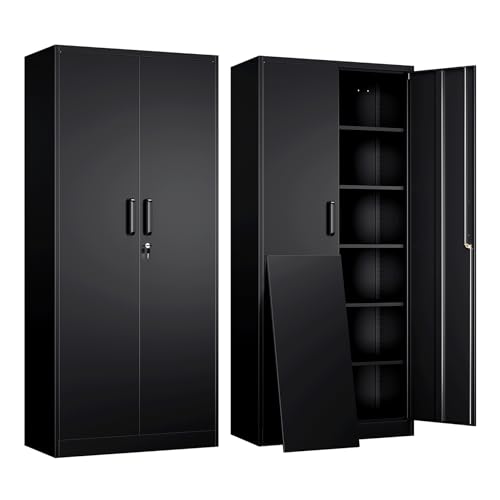
- 『HIGH QUALITY MATERIAL』:Whole-in-one reinforced heavy duty metal frame, load capacity up to 180lbs per shelf solid and strong.Environmental protection powder, scratch resistance
- 『PRACTICAL DESIGN』:Our tall metal cabinet equipped with lock and 5 adjustable shelves to provide adaptability and convenience. High-grade lock picking to secure valuables, two
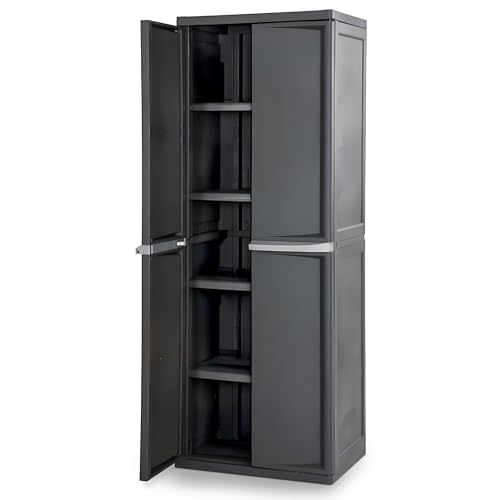
- Dimensions & Size: Exterior measures 25 5/8" x 18 7/8" x 69 3/8", with interior shelf dimensions of 17.65" width x 13.31" depth, providing ample storage space for various items
- Versatile & Practical: Whether in garages, basements, or throughout the home, our storage solution provides an ideal organizational solution. Accommodates a standard-sized padlock
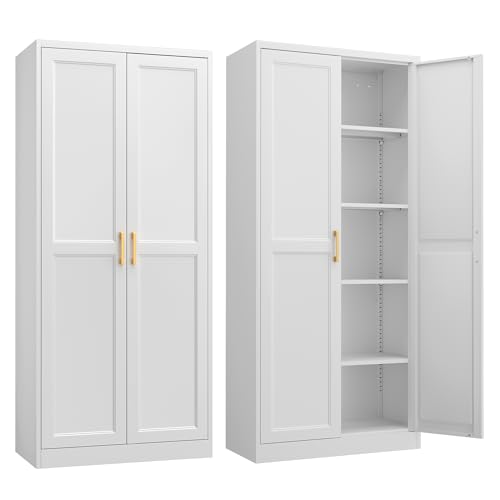
- 【Fashion and Sturdy Design】The white food pantry cabinet comes with 2 gold metal door handles,the beautiful lines emit an elegant atmosphere,the kitchen cupboard is made of
- 【Large Storage Space】The metal storage cabinet size is 71"H x 32"W x 16" D,the large size provides more storage space.The tall cabinet has 4 removable shelves with
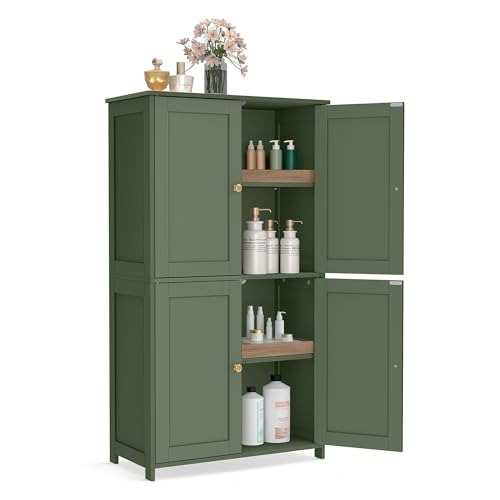
- Spacious & Versatile: This storage cabinet features 2 cupboards with 4 doors, providing roomy storage to organize home essentials in various spaces—kitchen, bathroom, utility
- Customizable Storage: Each cupboard, both top and bottom, features a shelf with 3 adjustable heights, allowing you to arrange the storage space to fit items of different sizes
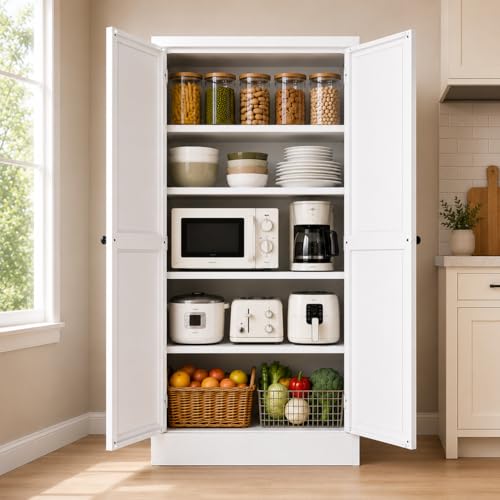
- Kitchen Pantry Cabinet – Stylish & Versatile Design:The AQY kitchen pantry cabinet features a sleek and modern look with a classic white finish, making it a perfect storage
- Ample Storage Space – Large Capacity Storage Cabinet:Measuring 14.78"D x 28.56"W x 61"H, this tall kitchen pantry storage cabinet offers plenty of room for appliances, dishes, and
The types, and what each one is actually for
Storage cabinets sort into four practical categories, and the material tells you almost everything about where it belongs.
Steel utility/garage cabinets are the workhorses. Powder-coated cold-rolled steel, adjustable shelves, usually a lock. They handle heavy, dirty, awkward stuff — tools, paint, sports gear, bulk supplies. High weight ratings, and the lock matters if you're storing anything a kid shouldn't reach.
The best storage cabinet buying guide for your situation depends on how you plan to use it and where.
Plastic cabinets are the humidity answer. They won't rust, dent, chip, or peel, and they usually assemble without tools. Trade-off: much lower shelf capacity. Great for a damp basement corner, wrong for engine parts.
Wood/MDF cabinets are the ones you put in a room people see. Doors, finishes, shaker panels. They're furniture that stores things rather than storage that happens to be furniture. Lower capacity again, and MDF hates standing water.
Pantry cabinets are a shape more than a material — tall, narrow-ish, deep enough for groceries and small appliances, with adjustable shelves so a stand mixer and a can of beans can coexist.
There's overlap. A steel pantry cabinet in white is genuinely both. But start from "what goes in it," not "what looks nice on the product page."
The buying checklist, in order
1. Measure the ceiling clearance, not just the floor. Most tall cabinets run 61–75 inches. That's fine under an 8-foot ceiling — until you try to tilt the assembled frame upright in a basement with ductwork. Assemble in place, or check you have the diagonal clearance. Gotcha: the listed height sometimes includes casters and sometimes doesn't.
2. Measure the interior shelf, not the exterior box. This is the step people skip. A cabinet that's 25 inches wide outside can have a 17-inch shelf inside. If you're storing 18-inch bins, you just bought a very nice place to not put them.
3. Check the door swing. Wing doors that open 180° need roughly the door's width of clear space on each side. In a narrow garage aisle or a galley kitchen, that's the difference between usable and permanently half-open.
4. Match shelf capacity to the heaviest single shelf, not the total. Cabinets advertise a per-shelf rating. Load the bottom shelf with the heavy stuff regardless — a top-heavy tall cabinet is the actual danger here.
5. Decide on the lock before you buy, not after. Some cabinets have integrated locks with keys. Some accept a standard padlock. Some have neither, and there is no retrofit that looks good.
6. Plan the anti-tip anchor. Every tall cabinet should be strapped or screwed to a stud. Check whether the unit has pre-drilled rear holes and whether hardware is included. Gotcha: if you're mounting to drywall with no stud, you need toggle anchors, and nobody includes those.
7. Decide mobile or fixed. Casters are great for garages where you rearrange. They also raise the center of gravity and make wall-anchoring pointless. Pick one philosophy.
8. Budget the assembly time honestly. Steel flat-pack cabinets are typically a 30-minute job with two people and closer to an hour alone, because holding a 6-foot panel upright while aligning screws is a two-hand problem with three hands' worth of work.
What goes wrong
Symptom: the doors won't close flush after assembly. Cause: the frame was tightened on an uneven floor, so it racked. Fix: back the corner screws off half a turn, square the frame with a level, shim the low foot, then retighten in a cross pattern.
Symptom: shelves bow in the middle within a month. Cause: you exceeded the per-shelf rating, or you loaded weight in the center span instead of near the supports. Fix: redistribute toward the ends, move heavy items down, and consider a shelf liner board.
Symptom: rust spots on a garage cabinet. Cause: powder coating got scratched during assembly, or the cabinet sits on a slab that wicks moisture. Fix: touch up scratches with enamel, and put the unit on feet or a mat rather than directly on bare concrete.
Symptom: the whole thing rocks when you open a door. Cause: no anti-tip anchor. Fix: anchor it today. This is the failure that hurts someone.
Symptom: the cabinet smells musty inside. Cause: sealed doors plus a damp room. Fix: crack the doors periodically or add a desiccant tub. Plastic and steel handle this better than MDF, which will swell at the edges.
Symptom: MDF cabinet edges are puffy near the floor. Cause: water exposure — a mopped floor is enough. Fix: none, really. That's why bathrooms and basements want plastic or steel.
Interior shelf dimensions are only published for the Sterilite (17.65" W × 13.31" D). For the others, assume the usable shelf is meaningfully narrower than the exterior width and measure on arrival before you commit to bin sizes. Check current listings and recent reviews yourself for anything a spec sheet can't tell you — panel fit, hardware quality, packaging damage rates.
When the fix is a new one
Letaya Metal Garage Storage Cabinets with Wheels,Steel Tool Cabinets Lock Door and Adjustable Shelves for Home,Office,Warehouse Organisieren (Black, 75" H) — mobility without giving up the lock
The Letaya Metal Garage Storage Cabinets with Wheels,Steel Tool Cabinets Lock Door and Adjustable Shelves for Home,Office,Warehouse Organisieren (Black, 75" H) runs detachable 360° swivel casters, so you can roll it out to sweep behind and then pull the wheels if you'd rather anchor it. It's 0.8mm steel with a three-point lock, four adjustable shelves, a 180 lb capacity, pre-drilled rear holes for wall mounting, and roughly 30 minutes of assembly with the included tools.
Sterilite 4 Shelf Cabinet, Durable Plastic Storage Solution, Gray, 1 Pack — the damp-basement answer
If rust is your recurring problem, the Sterilite 4 Shelf Cabinet, Durable Plastic Storage Solution, Gray, 1 Pack sidesteps it entirely — plastic that resists dents, chips, peeling and rust. It's the one unit here with published interior shelf dimensions (17.65" × 13.31"), it assembles with no tools, and it takes a standard padlock. The 40 lb per-shelf limit is the real constraint; this is for supplies, not steel.
Yizosh Metal Garage Storage Cabinet with 2 Doors and 5 Adjustable Shelves - 71" Steel Lockable File Cabinet,Locking Tool Cabinets for Office,Home,Garage,Gym,School (Black) — an extra shelf tier for heavy loads
The Yizosh Metal Garage Storage Cabinet with 2 Doors and 5 Adjustable Shelves - 71" Steel Lockable File Cabinet,Locking Tool Cabinets for Office,Home,Garage,Gym,School (Black) gives you five adjustable shelves instead of four in a similar footprint, each rated to 180 lbs, with a lock and two keys included. Doors open a full 180°, so budget the swing clearance.
Steeloong 71"Metal Pantry Storage Cabinet with Doors & 4 Adjustable Shelves — steel durability in a kitchen-friendly finish
The Steeloong 71"Metal Pantry Storage Cabinet with Doors & 4 Adjustable Shelves is white steel with gold handles and four removable, height-adjustable shelves in a 71" × 32" × 16" body. It ships with screws and reserved holes for wall anchoring, and the steel wipes clean — useful in kitchens and bathrooms where MDF would swell.
VASAGLE Floor Storage Cabinet, Shaker Cabinet with 2 Adjustable Shelves, 4 Doors, Tall Freestanding Organizer Unit, for Kitchen Bathroom Living Room, Forest Green UBBC553CH01S — when it has to look like furniture
For a room where a steel locker would be jarring, the VASAGLE Floor Storage Cabinet, Shaker Cabinet with 2 Adjustable Shelves, 4 Doors, Tall Freestanding Organizer Unit, for Kitchen Bathroom Living Room, Forest Green UBBC553CH01S reads as shaker cabinetry — recessed panels, forest green, two cupboards behind four doors. Each cupboard has one shelf with three height positions. It's MDF and includes an anti-tip kit; keep it away from standing water.
AQY Kitchen Pantry Cabinet,61" White Pantry Storage Cabinet with 4 Tier Adjustable Shelves and 2 Doors,Freestanding Cupboard,Metal Pantry Cabinets with Handle for Living Room Kitchen Assembly Required — the low-ceiling pantry option
At 61" tall and 14.78" deep, the AQY Kitchen Pantry Cabinet,61" White Pantry Storage Cabinet with 4 Tier Adjustable Shelves and 2 Doors,Freestanding Cupboard,Metal Pantry Cabinets with Handle for Living Room Kitchen Assembly Required tucks under lower ceilings and into shallower alcoves than the 71" units. Steel construction, four adjustable shelves, two doors, and a 28.56" width that fits narrower gaps.
FAQ
How many types of storage cabinets are there, really? Practically, four: steel utility, plastic, wood/MDF furniture-grade, and pantry-shaped units. Everything else is a variation — lockers, base cabinets, and tool chests are all steel utility with a different door arrangement.
Do I need to anchor a cabinet if it's full and heavy? Yes. A full cabinet is more dangerous when it tips, not less, and the tipping usually happens when someone pulls on an open door. Anchor anything over about four feet tall.
Metal or plastic for a garage? Metal if you're storing heavy tools — the capacity gap is large. Plastic if the garage floods, sweats, or you're storing chemicals that would eat a coating.
Can I put a steel cabinet in a bathroom? Powder-coated steel handles humidity better than MDF, but check that the finish is intact and don't let it sit in standing water. Plastic is the safest choice for a genuinely wet room.
Related guides
- Best Options for Best storage and organization furniture - bookshelves, storage cabinets, closet organizers, shoe racks, storage benches, pantry cabinets, cube storage, ladder shelves, coat racks, over the toilet storage
- Alternative Options for Best storage and organization furniture - bookshelves, storage cabinets, closet organizers, shoe racks, storage benches, pantry cabinets, cube storage, ladder shelves, coat racks, over the toilet storage
- About Shelvehaus: Our Editorial Team and Research Standards
Key Takeaways
- Choosing the right storage cabinet buying guide means matching the key features to your specific needs and budget
- Read real customer reviews and check the return policy before you commit
- Compare value across models — the priciest option is not always the best fit